☎ +1 (805) 498-2111 [email protected]

Semtech Innovation & R&D

Investing 15% of revenue in research to pioneer the wireless technologies that will define the next era of IoT connectivity.

Technology Roadmap

What We're Building Next

From advanced LoRa chipsets to AI-powered edge computing, explore the technologies shaping our research agenda.

Active Research

LoRa Edge AI

Integrating machine learning inference directly into LoRa chipsets, enabling real-time anomaly detection and pattern recognition at the sensor level without cloud roundtrips. Target: 95% reduction in unnecessary data transmission.

Active Research

Next-Gen LoRa Modulation

Developing enhanced chirp spread spectrum algorithms that double the data rate while maintaining the same link budget, enabling richer telemetry from battery-powered sensors without compromising range.

Pilot Phase

Direct-to-Satellite v2

Extending our satellite IoT connectivity to support bidirectional communication, firmware-over-the-air updates, and geolocation services for assets in the most remote environments on Earth.

Development

Multi-Protocol Fusion SoC

Single-chip solution combining LoRa, Bluetooth 5.4, Wi-Fi HaLow, and GNSS in a 7x7mm package. Designed for versatile IoT endpoints that seamlessly switch between network technologies.

Development

Ultra-Low-Power Sensing

Sub-microamp sleep current technology targeting 15-year battery life from a single coin cell, enabling deploy-and-forget sensor networks in structural health monitoring and environmental applications.

Exploration

6G-IoT Convergence

Early-stage research into how non-terrestrial networks, ambient backscatter, and terahertz sensing will converge to create a unified fabric of trillions of connected things in the 6G era.

15% Revenue in R&D
200+ Active Patents
12 University Partnerships
8 R&D Centers Worldwide
LoRa Alliance Ecosystem
Open Ecosystem

Building Together Through the LoRa Alliance

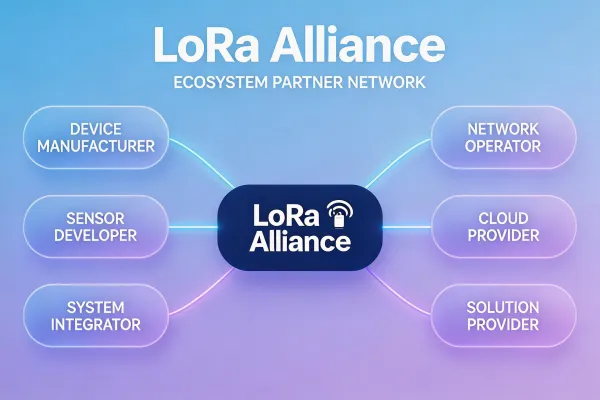
As co-founder and steward of the LoRa Alliance, Semtech drives the LoRaWAN open standard that enables interoperability across 190+ network operators in 170+ countries. Our ecosystem approach ensures that innovation scales through collaboration, not vendor lock-in.

  • 600+ LoRa Alliance member companies
  • 190+ public and private network operators
  • LoRaWAN Certified device interoperability program
  • Open specification maintained by industry consensus
Selection Considerations

Navigating Key IoT Connectivity Trade-Offs

Choosing the right wireless technology depends on deployment context. Here are two critical decision points our engineering team frequently addresses with customers.

5G mmWave vs. Sub-6 GHz for IoT Deployments

Millimeter wave (mmWave) 5G delivers massive bandwidth with up to 800 MHz channels and ultra-low latency, making it suitable for high-density venue coverage and industrial IoT applications requiring real-time control. However, mmWave requires significantly denser infrastructure due to limited penetration through walls and vegetation, increasing deployment costs.

Sub-6 GHz 5G offers superior coverage and building penetration at lower infrastructure density, making it more cost-effective for nationwide IoT rollout. The trade-off is reduced peak bandwidth compared to mmWave. For many LPWAN IoT use cases, sub-6 GHz combined with LoRaWAN provides the optimal balance of coverage, power efficiency, and cost.

Semtech's position: We support both approaches through our multi-protocol platforms. Our recommendation depends on the specific use case — mmWave for high-throughput applications like video analytics, sub-6 GHz + LoRaWAN for distributed sensor networks where coverage and battery life matter most.

Single-Vendor Stack vs. Open Networking Standards

Single-vendor integrated stacks provide a unified management plane, a single point of support, and proven interoperability, enabling faster deployment cycles. This approach works well for organizations prioritizing operational simplicity and established vendor relationships.

Open and disaggregated networking (OpenConfig, SONiC, LoRaWAN) avoids vendor lock-in, allows best-of-breed component selection, and often reduces hardware costs through white-box options. The trade-off is increased integration complexity and potentially fragmented support.

Semtech's position: As co-founder of the LoRa Alliance, we advocate for open standards. LoRaWAN's interoperability across 190+ network operators demonstrates that open ecosystems accelerate adoption. However, we acknowledge that for mission-critical deployments with strict SLA requirements, a more integrated approach may reduce risk during initial rollout.

Technical Considerations for LoRa Deployments

Understanding the engineering constraints of LPWAN technology helps ensure successful deployments.

Bandwidth Constraints

LoRa operates at data rates between 0.3 kbps and 50 kbps depending on spreading factor and bandwidth configuration. This makes it unsuitable for high-throughput applications such as video streaming or large file transfers. Optimal use cases involve small sensor payloads (typically under 242 bytes per transmission).

Range vs. Environment

The advertised 15 km range applies to line-of-sight rural conditions. In dense urban environments with multi-story buildings, effective range typically decreases to 2-5 km. Indoor penetration varies significantly based on building materials — concrete and metal structures attenuate signals more than wood or drywall.

Duty Cycle Regulations

In EU regions operating on the 868 MHz ISM band, LoRaWAN devices are subject to a 1% duty cycle limitation, restricting each device to approximately 36 seconds of airtime per hour. This constrains the frequency and volume of data transmissions and must be factored into application design, particularly for time-critical alerting use cases.

Partner With Our R&D Team

Join our Early Access Program or explore joint innovation opportunities to shape the future of IoT connectivity.